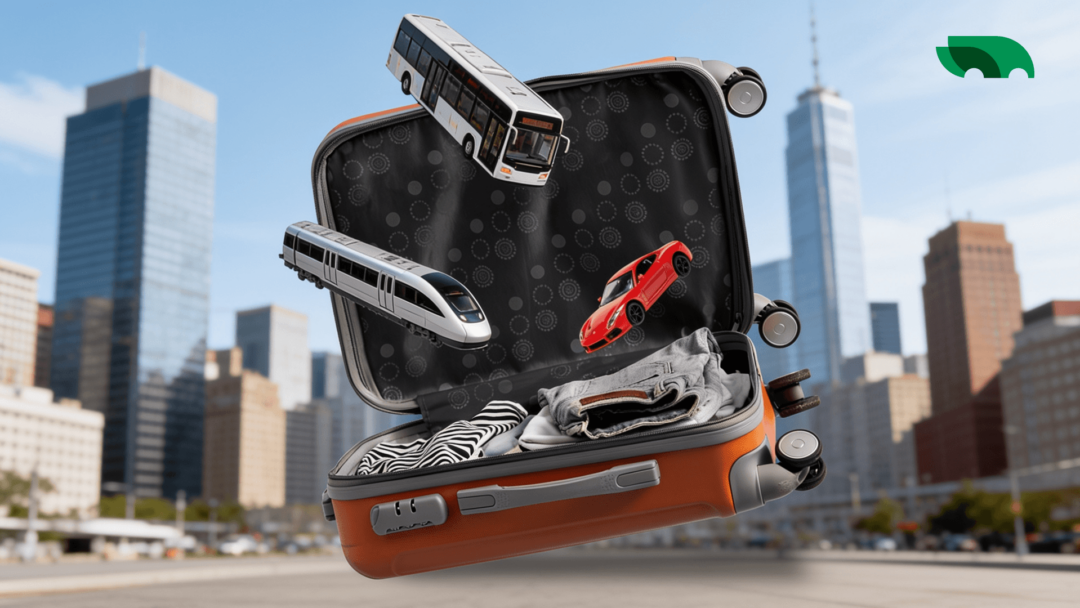
What do you think is the best way to travel between cities? For most intercity trips, the bus is the smartest way to travel. It’s the cheapest per mile, the lowest in carbon emissions, and roughly six times safer than driving yourself.
The train wins when you need raw speed on a busy corridor, and the car wins only when you’re hauling a lot of cargo or making many off-route stops.
However, for a single traveler going city to city, a coach like OurBus usually beats both on the numbers that matter.
So how do you actually choose between a bus, a train, and your own car for a trip between two cities? It comes down to five things: price, time, safety, carbon, and what you can do with the hours in transit. Let’s put all three modes side by side and see which one wins on each – and when the “obvious” choice isn’t the smart one.
Which Is Cheaper: Bus, Train, or Car?
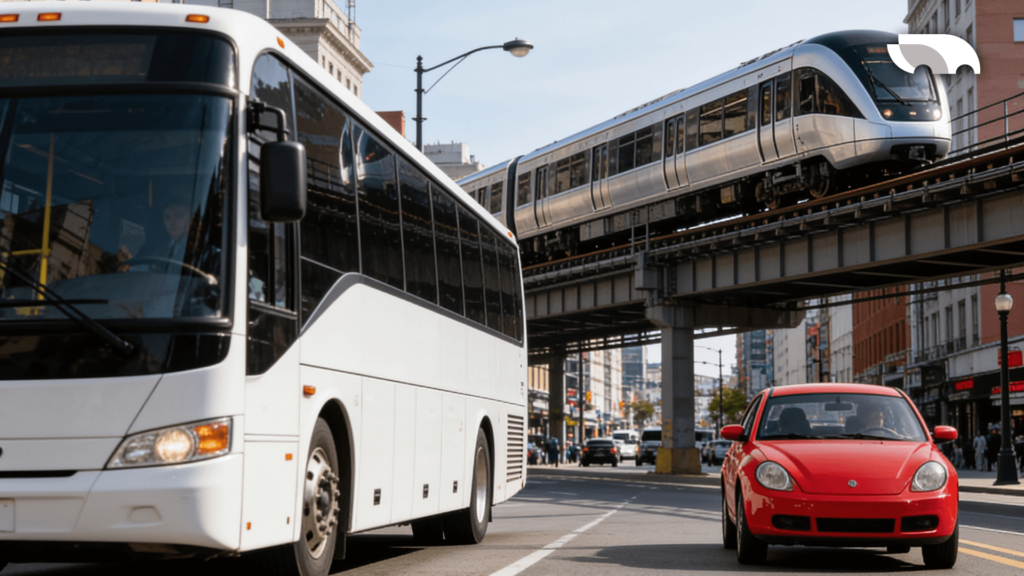 The bus is almost always the cheapest way to travel between cities. A car looks “free” once you own it, but the real cost of a new vehicle at $11,577 a year, or about 56 cents per mile for a small sedan – fuel alone is 13 cents of that. A bus seat costs a fraction of that per mile, with no gas, tolls, or parking on top.
On a 200-mile intercity trip, that’s about $145 of real driving cost one way, before parking. A bus fare for the same trip often runs a small fraction of that.
The train sits in the middle. On the Northeast Corridor, Amtrak’s Northeast Regional is cheaper than the premium Acela, but both typically cost more than the bus on the same route (Amtrak, Nov 2025).
And flying? US airfares were up about 20% year over year by spring 2026, pushing more travelers toward ground transport (U.S. Travel Association, 2026).
How Do a Bus, Train, and Car Compare Side by Side?
Here’s the head-to-head. The bus leads on cost, emissions, and safety; the train leads on top speed; the car leads only on flexibility and cargo. The table below is our own side-by-side so you can pick a mode in about thirty seconds.
| Factor | Bus (coach) | Train (Amtrak) | Car (solo) |
| Cost per mile | Lowest (fare only) | Medium | Approximately 56 cents |
| CO₂ per passenger-mile | 0.05 kg | 0.07 kg | 0.22 kg |
| Safety (deaths/100M pass-mi) | 0.09 | 0.01 | 0.53 |
| Door-to-door flexibility | Fixed stops | Fixed stations | Anywhere |
| Can you work/sleep en route? | Yes | Yes | No |
| Parking & tolls | None | None | You pay |
| Best for | Cost, solo trips, green travel | Speed on busy corridors | Cargo, many stops |
No single mode wins every row. But notice the pattern: the bus is either first or a close second on every factor except top speed and door-to-door flexibility. That’s what “smartest” looks like in practice – not the best at one thing, but rarely the worst at anything.
Which Is the Greenest Way to Travel Between Cities?

The bus is the greenest-powered way to travel city to city. A coach emits about 0.05 kg of CO₂ per passenger-mile, versus 0.07 for a train, 0.22 for a solo petrol car, and 0.31 for a domestic flight. A solo driver puts out more than four times the carbon of the same trip by coach.
If you fill a car with four people, its per-person emissions drop sharply, and the gap narrows. But for the solo or two-person trips that make up most intercity travel, the coach is the cleanest choice – and you don’t have to organize a carpool to get there.
Is the Bus or Train Safer Than Driving?
Both the bus and the train are dramatically safer than driving yourself. Per 100 million passenger-miles, cars and light trucks see about 0.53 deaths, buses about 0.09, and passenger rail about 0.01 (National Safety Council / BTS, 2023–24). That makes driving roughly six times deadlier than the bus and far more dangerous than rail, mile for mile.
The reason is simple: a professional driver, a heavier vehicle, and no temptation to text, speed, or drive exhausted. When you take the bus or train, you hand the wheel to someone whose only job is getting everyone there safely. Want the cost-and-safety case in one place? Then the bus is the best way to travel, as it’s both cheap and safe!
For college students, OurBus can be the favorite go-to ride due to the affordability and convenience it offers. You can check routes like NYC to Ithaca, NYC to Rochester, NYC to Buffalo, NYC to DC, etc. You can also get your hands on a Super Saver Pass by OurBus that allows you to ride more while spending less.
What Can You Actually Do During the Trip?

This is where the car loses badly. On a bus or train, every minute is yours – you can work, sleep, read, or stream. Behind the wheel, you can do none of that, and you pay for it: US drivers lost an average of 43 hours and about $771 each to traffic congestion in 2024, and drivers in NYC and Chicago lost 102 hours – $1,826 each (INRIX, Jan 2025).
Think of a four-hour bus ride as four hours back. You can clear your inbox, finish a deck, or just nap before you arrive – none of which is possible while you’re white-knuckling an interstate. That recovered time is the quiet advantage that doesn’t show up on a fare comparison but changes how you feel at both ends of the trip.
When Does the Train or Car Actually Win?
The bus isn’t always the answer – pick the train for speed and the car for cargo. On dense corridors, Amtrak set an all-time record of 34.5 million trips in FY25, up 5.1%, because trains can beat both road modes when highways clog (Amtrak, Nov 2025). If shaving an hour matters more than saving money, the train earns its higher fare.
The car wins in three specific cases: you’re carrying bulky cargo, you’re making several stops off the main route, or you’re splitting fuel four ways on a group trip. In those situations, the per-person math and door-to-door flexibility tilt toward driving. For everything else like a solo or two-person trip between two cities, the bus usually comes out ahead.
For most city-to-city trips, the bus is the best way to travel: cheapest per mile, lowest in carbon, and far safer than driving, while giving you the hours back to work or rest. The train is the move when speed on a busy corridor beats price, and the car earns its keep only for cargo, multi-stop routes, or full four-person carpools.
Ready to compare your specific route? Check live fares and times on the www.ourbus.com
Here’s a quick takeaway:
- Cheapest: the bus – no gas, tolls, or $11,577-a-year car costs.
- Greenest: the bus at 0.05 kg CO₂ per passenger-mile.
- Safest: rail, then the bus – both far ahead of driving.
- Fastest on busy corridors: the train.
- Most flexible for cargo and stops: the car.
Pick your two cities, check the live fare, and book your seat on Ourbus.com.
You can also book a private vehicle for group travel on ourbuscharters.com. Get a customized quote for your personalized itinerary!
Frequently Asked Questions
1. Is the bus cheaper than the train and car for intercity travel?
Usually, yes. A small sedan costs about 56 cents per mile to run, and a new car costs $11,577 a year all-in (AAA, 2025). Amtrak’s Northeast Regional beats the Acela on price but typically costs more than the bus, which carries no gas, toll, or parking charges.
2. Which is safer, the bus or driving?
The bus is far safer. Per 100 million passenger-miles, buses see about 0.09 deaths versus 0.53 for cars – roughly six times safer (National Safety Council / BTS, 2023–24). Passenger rail is safer still at 0.01. A professional driver and a heavier vehicle are the main reasons for the bus’s safety advantage.
3. When is driving actually the smarter choice?
Driving wins when you’re hauling bulky cargo, making several stops off the main route, or splitting fuel among four people on a group trip. In those cases the per-person cost and door-to-door flexibility favor the car. For solo or two-person city-to-city trips, the bus is usually cheaper and less stressful.
4. Why are more people taking the intercity bus in 2026?
Cost! Intercity bus ridership was projected to grow about 4% in 2025, outpacing air and auto, as gas and airfares climbed. With airfares up about 20% year over year, the bus is the value pick for ground travel.


No Comments