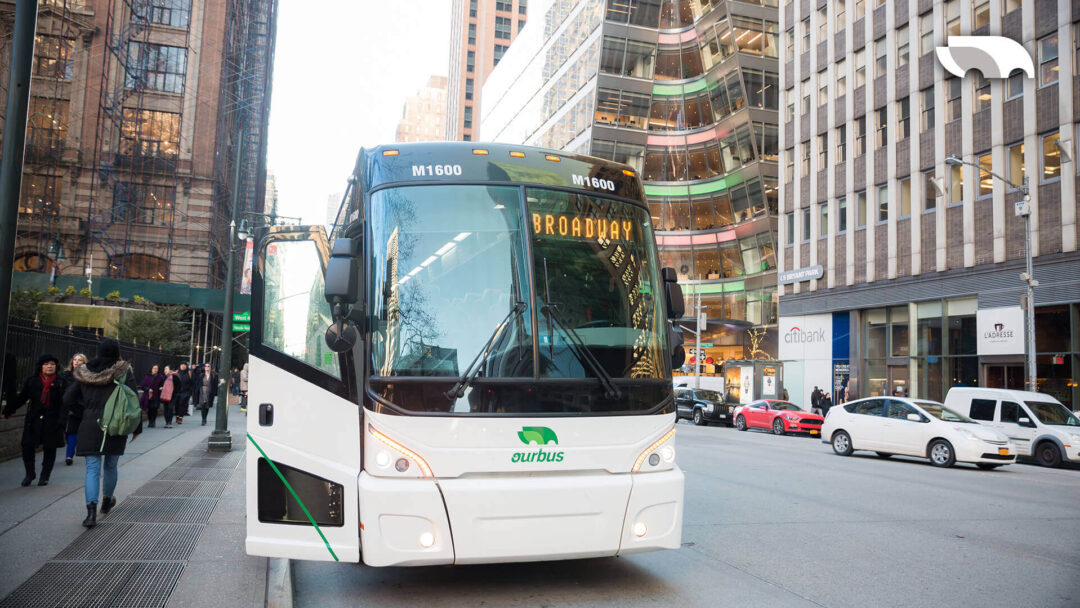
Because a bus stop only has to be a place a coach can legally pull in and passengers can wait, and a building is one way to do that, not a requirement. Read a run of route pages, though, and the premise falls apart. We found the choice isn’t sidewalk or station at all. It’s terminals in a couple of cities, curbs in most, and a stranger category besides that includes a shopping mall, a gas station lot, an airport and a turnpike service plaza. Most of the stops we read are curbside, but OurBus genuinely uses buildings too, and the pattern behind which you get is more legible than it looks.
What those stops have in common is simple: each one exists already, takes a coach, and belongs to somebody willing to say yes. A station clears that bar where a city happens to have one. Plenty of other places clear it everywhere else.
What kinds of stop does OurBus actually use?
More than two. Reading across the route pages in the table below, we found four distinct kinds of stop in use, which is why “sidewalk versus station” never quite describes a trip.
| Kind of stop | Where it shows up |
|---|---|
| Bus terminal with numbered gates | Port Authority Bus Terminal, Gate #21, and the George Washington Bridge Bus Station, Level 3, Slip 2, both in New York; the Philadelphia Parking Authority Transportation Center on Filbert Street, Gate 4 |
| A bus terminal or platforms at another transit building | the Union Station Bus Terminal in Washington, at Slip 30; Mountaineer Station at West Virginia University, where the stop is the bus platforms in front |
| Marked curb on a public street | Hudson Yards, on 11th Avenue between West 35th and West 36th |
| Somewhere that exists for an entirely different reason | the Maple Road Sunoco near SUNY Buffalo; Philadelphia Mills Mall in Northeast Philadelphia; the bus pickup area at Buffalo Niagara International Airport; the Woodrow Wilson Travel Plaza on the New Jersey Turnpike |
Compiled from the OurBus route pages listed in Sources, read in October 2026. Exact addresses live on each route page, and your booking confirms which stop applies to your trip.
That fourth row is the interesting one. A gas station lot outside a university campus and a service plaza on a toll road each have a paved area a coach can enter, somewhere to stand, and someone whose permission can be obtained.
Each one is also solving a specific access problem. The shopping mall is the oddest of them until you read the label: the route page calls that stop “Philadelphia Mills Mall (Free Day Parking).” That parking is the mall’s arrangement, not something OurBus provides, so anything beyond a day is a question for the property. A gas station on a road into a university sits where the campus is walkable but a terminal isn’t. A turnpike plaza sits where a highway route can pause without leaving the road at all. A curbside stop is the version of this most riders meet, and the gas station is the clearest illustration of why: it meets what a stop needs, and was never built for a coach at any point.
Why not just use the bus station?
Often because the route pages list none in that city, and sometimes because a building exists but isn’t available to this bus. Terminals with numbered gates turn up in the biggest cities — on these routes, New York and Philadelphia. Washington uses a bus terminal inside Union Station, a building that already existed for the trains, at Slip 30. A slip is a marked bay where one coach pulls in, which is a different thing to find than a street corner. Across the seven route pages we read, we found a building in use in four cities and a curb or an existing lot everywhere else. So what decides it? The pattern follows what a city already happens to have, not how big it is. And gates inside a terminal are limited, so access has to be granted by whoever runs the building.
Why that lands on the curb so often has something to do with how the service is built. First, the limit of what we can see here: the contracts behind stop access are not public. We’re not going to pretend to have read them. What is public is the model. OurBus supplies the booking platform and licensed regional operators run the vehicles, which lets small firms open thin corridors. The guide to who runs OurBus buses covers how those route decisions get made. A small firm opening one corridor is unlikely to be negotiating terminal access in half a dozen cities. On the evidence of where these stops actually are, it doesn’t need to. Does that hold a fare like the $9 starting price on the bus from NYC to Philadelphia down? Not something we can show, so we won’t claim it.
What’s visible is the pattern: buildings show up where a city already has one open to intercity coaches, and curbs show up everywhere else.
Does it change how you should plan?
Yes, in one specific way worth knowing before you travel. The two kinds ask different things of your arrival.
At a curb, the stop is the spot. You arrive at the published time, see the coach, and board. The main risk is standing on the wrong corner. A terminal puts a building between you and the bus: a concourse to cross, a gate or slip number to find, sometimes a level to change. Consider the two New York terminals in the table above. The George Washington Bridge Bus Station is one, run by the Port Authority in upper Manhattan. One route page puts the OurBus drop there at Level 3, Slip 2, connected to the A train at 175th Street. A level and a slip number are both things you have to go and find. So the walk-in is a genuine part of that journey.
So how much margin do you actually need? More at a terminal than at a curb — and your route page carries OurBus’s own arrival guidance, which is the number to work from rather than a guess. What the city name alone won’t tell you is whether there’s a building between you and the coach. The route page will.
What does this mean for a group?
It means the stop type is worth checking before you promise everyone a meeting point. A curbside stop may have no shelter and nowhere indoors to wait. A crowd standing on a sidewalk in bad weather is a different experience from the same crowd in a waiting room. The practical problem is the landmark. “The stop on 11th Avenue” means less in a group message than a gate number inside a terminal does, especially when people arrive separately. If a group needs a predictable place to assemble, a vehicle that comes to them solves it. That’s what OurBus Charters is for: its group transportation services pick up at an address you choose, subject to access at the location.
For a solo trip, none of this is a problem once you know which kind of stop you’ve booked. Check fares and your boarding point on the route you want, and read the stop line twice.
Frequently Asked Questions
Does OurBus use bus stations or street stops?
Both. Most of the stops we read are curbside, but the network also uses terminals such as Port Authority in New York, bus terminals inside other transit buildings such as Union Station in Washington, and a range of other locations including mall lots and an airport pickup area. Your route page says which applies.
Why do intercity buses stop on the street instead of at a terminal?
Because many of these route pages list no terminal in the city at all, and where one exists its gates are limited and allocated by whoever runs the building. A legal curb with a published address serves the same function, which is one reason curbside stops are common on thin corridors.
Is a curbside stop worse than a station?
It’s a trade. A curb may have no shelter or departure board, but it also has no concourse to cross, so you can arrive closer to the departure time. A terminal gives you somewhere to wait and a gate number to find.
How do I know which kind of stop my trip uses?
The route page lists every pickup and drop-off point with a description, and your booking confirms the one that applies to your trip. Read that line before you travel, since a single route can list several stops in the same city.
Do all OurBus routes in one city use the same stop?
No. A route can list several pickup points in the same city, and different routes serving the same city can use entirely different kinds of stop. New York is the clearest case, with curbside pickups and two separate terminals in use depending on the corridor.

No Comments