
Many do, and the newer the coach, the more certain the answer. Federal law has required lap and shoulder belts at every passenger seat on new over-the-road buses since November 28, 2016. OurBus trips run on coaches owned by independent partner operators, and fleets mix newer and older vehicles — so belts vary by the specific coach, and the practical rule is simple: if your seat has one, wear it.
This is a question OurBus itself doesn’t answer anywhere — we found no seatbelt mention across the FAQ, the help center, or the route pages when we checked on September 7, 2026 — which is exactly why it’s worth answering from the primary source instead. The primary source is a federal safety standard, and it’s unusually clear.
What Does the Federal Seatbelt Rule Actually Say?
In 2013, the National Highway Traffic Safety Administration issued a final rule amending the federal motor vehicle safety standard on occupant crash protection “to require lap/shoulder seat belts for each passenger seating position in all new over-the-road buses,” with an effective date of November 28, 2016 — the full text is in the Federal Register at govinfo.gov. An over-the-road bus is the regulation’s term for the intercity coach: elevated deck, luggage bays underneath, the vehicle this entire industry runs on. The rule’s own summary states its purpose plainly: requiring the belts “significantly reduces the risk of fatality and serious injury in frontal crashes and the risk of occupant ejection in rollovers.” Note what the rule covers — new buses. It set a floor for every coach built from late 2016 onward, and coaches built earlier may predate the requirement, which is the entire reason the answer to this post’s question is “check your seat” rather than a flat yes.
Why Does It Vary Bus to Bus on OurBus?
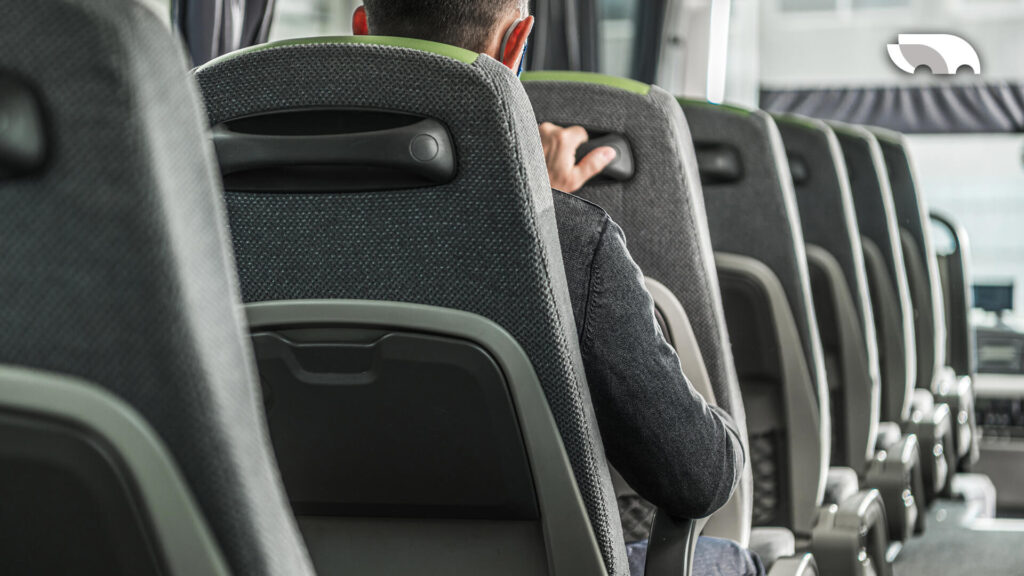
Because OurBus doesn’t own a fleet. A partner operator is an independent, licensed bus company that owns the coach and provides the driver, and OurBus trips run on those operators’ vehicles — a model we’ve covered in detail in who runs OurBus buses. More than 400 operators have run trips on the platform, and each maintains its own vehicles of various model years. That’s why no single belt promise appears on the OurBus site, and honestly, why one shouldn’t: the accurate answer lives at the level of the individual coach. A newer vehicle will have three-point belts at every seat because federal law required them at manufacture; an older one may not. For example, on a long haul like the 7.5-to-8.5-hour Buffalo run — the trip where this question feels most real — the coach that arrives is the operator’s, and its build year decides its belts.
So what should a rider actually do? Three things. Look for the belt when you sit down; it’s at the seat or it isn’t, and no website can check for you. Buckle it if it’s there — the rule exists because belts change outcomes in exactly the crashes that matter most on highways. And seat children thoughtfully: a car seat can be brought if required, per the OurBus FAQ, and a belted seat is where it belongs.
Is a Coach Without Belts Unsafe?
No — it’s a coach built to the standard of its day, and motorcoach travel’s overall safety record has never rested on belts alone. Coach passengers sit high above collision height in a heavy vehicle driven by a professional on rest-managed schedules; the 2016 rule added a layer of protection to that baseline, particularly against the rollover-ejection scenario its summary names. It’s worth being precise here rather than alarmist, and the precision cuts both ways. Would we choose a belted seat over an unbelted one when boarding early gives the choice? Yes, every time — and open seating is what makes the choice yours: arrive 15 minutes early, board near the front of the line, and for instance take the belted row over the unbelted one when a mixed cabin offers both. Does an older coach make the trip dangerous? The federal record the rule itself is built on says the risk it addresses is concentrated in rare, severe events — real enough to regulate, rare enough that the industry carried its reputation for safety long before 2016.
For group organizers, the operator question can be asked before anyone boards: OurBus Charters’ group transportation states that it partners only with carriers holding satisfactory DOT safety ratings and current insurance, with vehicles inspected before dispatch — and a charter quote conversation is a fine place to ask about belts, vehicle age, and anything else your group’s parents will ask you.
Frequently Asked Questions
Are seatbelts required on all buses?
On new over-the-road buses, yes — every passenger seat, lap and shoulder, since November 28, 2016 under the federal occupant-protection standard. Coaches manufactured before the rule may lack them, which is why fleets show a mix.
Should you wear the seatbelt on a coach if it has one?
Yes. The rule’s stated purpose is reducing fatality and serious injury in frontal crashes and ejection in rollovers — the two scenarios where a highway coach’s size stops protecting you. Buckling costs four seconds.
Can you ask which bus you’ll get before booking?
The specific coach isn’t published at booking — assignments sit with the operator running your trip. Boarding early gives you a look at the cabin and, with open seating, the pick of a belted seat when the coach has them.
Do kids need car seats on OurBus?
The FAQ says a car seat can be brought if required, and every child needs their own ticket, so there’s always a seat to install it on. A belted row is the right home for one — a genuine reason for families to board early.

No Comments