
No. OurBus does not allow animals or pets of any kind, with one exception: trained service animals assisting a traveler, kept in a harness and under the passenger’s control at all times. An emotional support animal does not qualify, a carrier does not change the answer, and no size of dog is small enough. That is the whole policy, and we verified it on the OurBus FAQ on September 3, 2026.
OurBus is a tech-enabled intercity bus service running scheduled routes across the Northeast, and like most scheduled carriers it publishes far less about animals than airlines do — one paragraph, in fact, and people read into the silence. So this post does the opposite of hedging. We analyzed the FAQ, the help center, and the federal definitions the policy leans on, and laid out what each phrase actually means when you’re standing at the curb with a leash in one hand and a ticket in the other.
What Does the OurBus Pet Policy Actually Say?
Here it is, quoted in full from the OurBus FAQ: “OurBus does not allow animals or pets of any kind, except for trained service animals assisting a traveler. Service animals must be in a harness and under the control of a passenger at all times.”
Two phrases do all the work. “Of any kind” closes the loopholes people hope for — cats in carriers, pocket-sized dogs, a hamster in a backpack. And “trained service animals” imports a precise legal definition rather than a vibe. We found no deeper rules anywhere else: the help center at support.ourbus.com has no pets article, so that FAQ answer is the entire published policy. There is no weight limit to look up and no pet fee to pay, for example, because there is no pet option to buy. Here is the short version of every scenario we get asked about:
| Animal | Rides on OurBus? | Why |
|---|---|---|
| Trained service dog | Yes | ADA-defined; harness + handler control required |
| Emotional support animal | No | Comfort by presence is not a trained task |
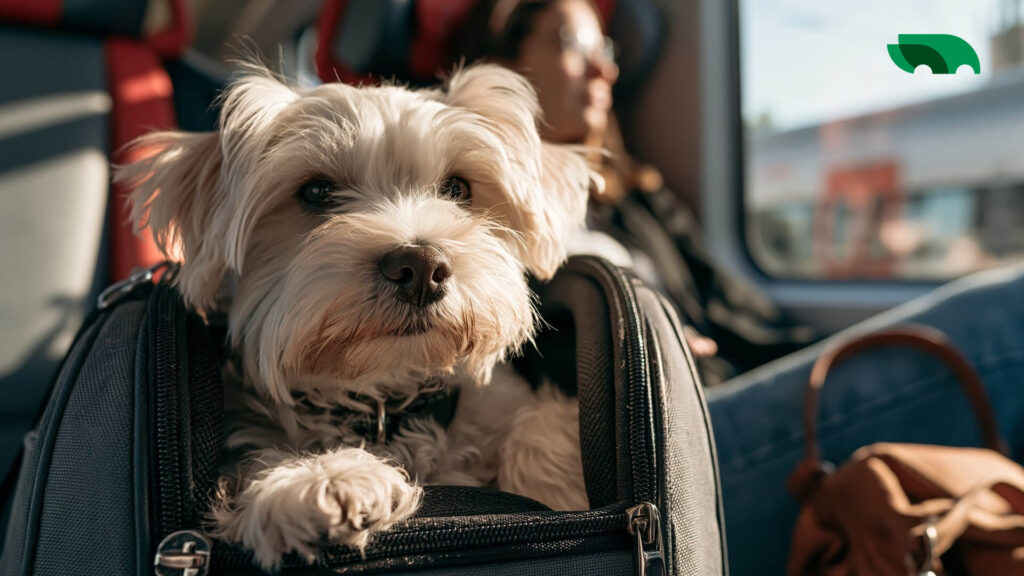
| Cat or dog in a carrier | No | “Animals or pets of any kind” — the carrier changes nothing |
| Any other pet | No | Same clause; no fee or waiver exists |
Policy text and table verified against the OurBus FAQ, September 3, 2026.
What Counts as a Service Animal, and What Doesn’t?
A service animal is a dog that is individually trained to do work or perform tasks for a person with a disability — that is the definition under the Americans with Disabilities Act, published at ADA.gov. Guiding a handler with low vision, alerting to a seizure, retrieving medication: those are trained tasks. The same ADA guidance is equally clear about the other side: “dogs whose sole function is to provide comfort or emotional support do not qualify as service animals.”
When it is not obvious what a dog does, the ADA permits staff exactly two questions: is the dog a service animal required because of a disability, and what work or task has the dog been trained to perform. Staff may not ask about your diagnosis, demand papers, or ask the dog to demonstrate. Notice what that means in reverse — there is no official service-dog “certificate,” so what would a laminated card from an online registry actually prove? Nothing, in either direction. If you travel with a service dog, the practical checklist is short: book a normal ticket, bring the harness, keep your dog at your feet and under control, and arrive at the stop 15 minutes early like every other rider.
Why Doesn’t an ESA Letter Change Anything?
An emotional support animal is an animal whose presence comforts its owner without task-specific training, and the distinction is not a technicality — it is the entire dividing line. A therapist’s letter describes why the animal helps you; it does not convert comfort into a trained task, so it does not move a pet across the ADA’s line. Airlines reached the same conclusion years ago, which is why ESA letters stopped working there too. On OurBus the answer is simply the policy quoted above: no animals of any kind except trained service animals. It costs nothing to ask rider support about your specific situation before travel day, and that is genuinely the right move for any edge case, because the driver at the curb cannot waive the rule for you. What a driver can do is enforce it, which makes travel day the worst possible time to find out your plan doesn’t work.
What Can You Do Instead?
So what do you actually do with the dog while you travel? Plan for the pet before you book, not after. For a weekend trip, that usually means a sitter, a boarding kennel, or the friend who owes you one — and honestly, a 4-hour ride in a coach cabin was never going to be your dog’s favorite afternoon anyway. For instance, a rider doing the NYC to Boston route is looking at 4 to 4.5 hours each way; boarding the dog locally often costs less than the round trip and spares everyone the stress. Fares themselves leave room in the budget for it: the NYC to Philadelphia bus starts at $9 and runs 19–20 times a day, so the trip itself is rarely the expensive part of the weekend.
If the trip is a one-way move and the pet must come, scheduled service is the wrong tool, full stop. A group traveling together — a family relocating, a club heading to a show circuit — can ask about vehicle rules directly when requesting a free quote from OurBus Charters, because on a private charter the trip is arranged with the operator rather than governed by one network-wide rule. Note that Charters publishes no pet policy either; it is a conversation to have with the trip expert, not a promise to assume.
Frequently Asked Questions
Can you bring a cat or small dog in a carrier on OurBus?
No. The policy bars animals or pets “of any kind,” and a carrier does not create an exception. The only animals that ride are trained service dogs, harnessed and under the handler’s control.
Does a service dog need its own ticket?
Nothing on the OurBus site says a service animal needs a separate ticket. Since the site is silent, confirm with rider support when you book rather than assuming either way.
What are the two questions staff can legally ask about a service dog?
Under the ADA: whether the dog is a service animal required because of a disability, and what work or task the dog has been trained to perform. Requests for documentation or a demonstration are not permitted.
Does OurBus charge a pet fee?
No, and that is the tell. There is no pet fee because there is no pet option — the only animal category the policy recognizes is trained service animals, which ride free of any charge.



No Comments